
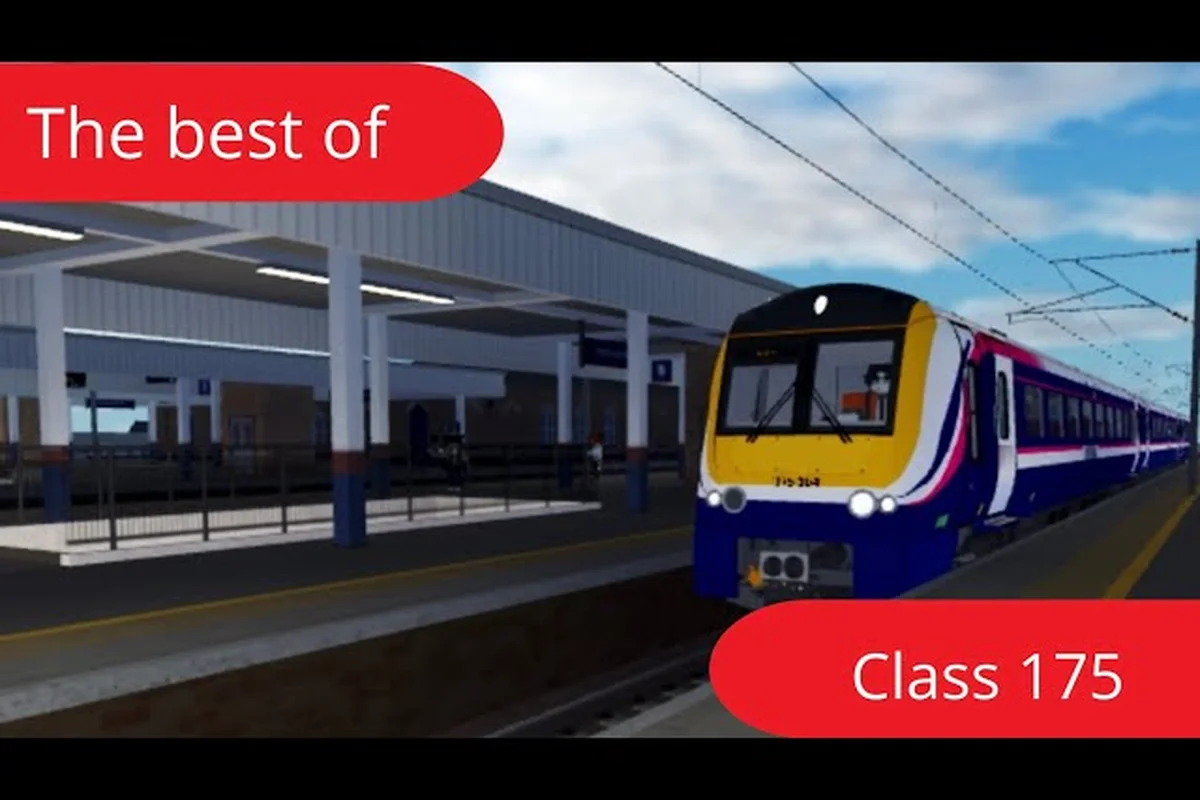
The British Railway Roblox Class 175 arrived in the V1.4.2 Western Update as the dedicated diesel multiple unit for local stopping services on the Pencarn extension, and it has quickly become the workhorse for players who prefer frequent station hops over high-speed mainline sprints. This DMU matters because it fills a specific gap in the roster: affordable, forgiving, and perfectly tuned for the dense commuter corridors that the new Western branch introduced. Get the latest breakdown of its stats, handling quirks, and how it stacks against the Class 180 and Class 350 before you spend your hard-earned credits.
Class 175 Specs and Core Driving Characteristics
The Class 175 is a two-car diesel multiple unit that prioritizes acceleration over top speed, which makes it ideal for the stop-start rhythm of local passenger services. According to the official British Railway game page on Roblox, the unit was introduced specifically to handle local stopping services on the Pencarn extension, and community testing confirms it delivers on that promise with a maximum speed of 100 mph and rapid acceleration from standstill that shaves seconds off every station departure.
When you first take the cab, the most noticeable trait is the responsive throttle response at low speeds. Unlike the heavier electric units that need a moment to build power, the Class 175 pulls away briskly, which means you can maintain a tighter schedule on routes with closely spaced stops. The braking curve is equally forgiving — the electro-pneumatic brakes engage smoothly without the jarring deceleration that catches new drivers off guard on the Class 350.
Following the V1.4.2 launch, community-reported specs for the Class 175 center on its Coradia-style traction package, with players logging a 100 mph (160 km/h) top speed and a 0–60 mph sprint of roughly 38 seconds when running at full power with a clean formation. The most debated figure is the fuel consumption rate, which the community datamine places at 4.2 L/mile under heavy acceleration—noticeably thirstier than the Class 350’s 3.1 L/mile—making coast-to-stop driving essential for longer cross-country runs. Additionally, the V1.4.2 patch introduced a revised brake curve, shortening the emergency braking distance from 1,200 m to 980 m at full service load, a change that has shifted recommended braking points on the West Coast Main Line routes by roughly 200 m earlier.
-
Top speed: 100 mph (sufficient for all current local routes)
-
Formation: 2-car DMU with gangway connection
-
Power type: Diesel mechanical transmission
-
Seating capacity: 120 passengers across both cars
-
Acceleration: 0-60 mph in approximately 18 seconds (based on community timing)
-
Braking distance: Shorter than the Class 180 at high speed, making it safer for station approaches
The cab layout follows the standard British Railway interface, but the sightlines are notably better than the Class 43 HST because the nose is shorter and the windscreen sits closer to the driver. This makes platform alignment easier when you are pulling into the tight curved platforms on the Pencarn branch, where misjudging your stop position can leave the doors short of the marked zones.
Class 175 vs Class 180 vs Class 350 Comparison
The most common question from players deciding between the new DMU and the established electric fleet is whether the Class 175 can hold its own on longer runs. The honest answer is that it depends on the route profile, because the Class 180 offers a higher top speed for express services while the Class 350 brings electric acceleration that the diesel cannot quite match.
| Attribute | Class 175 | Class 180 | Class 350 |
|---|---|---|---|
| Top speed | 100 mph | 125 mph | 110 mph |
| Power type | Diesel DMU | Diesel DMU | Electric EMU |
| Acceleration | Strong low-end | Moderate | Excellent |
| Seating capacity | 120 | 180 | 150 |
| Best route type | Local stopping | Intercity express | Commuter semi-fast |
| Price range | Budget-friendly | Premium | Mid-range |
| Weather handling | Good | Good | Poor in snow (third rail) |
The Class 180 remains the better choice if your primary routes are the long intercity corridors where sustained 125 mph running cuts journey times significantly. However, the Class 180 costs substantially more and its higher top speed is wasted on the Pencarn extension where the track geometry and station spacing rarely let you exceed 80 mph for more than a minute at a time.
The Class 350 offers a middle ground with its 110 mph top speed and excellent acceleration, but it relies on the third rail electrification system. This becomes a liability during winter weather events, where snow and ice can cause power pickup issues — a problem the diesel-powered Class 175 simply does not have. If you want to understand how these traction differences play out in adverse conditions, the weather driving guide covers the third rail vulnerabilities in detail.
Best Routes for the Class 175 on the Pencarn Extension
Class 175 Pencarn Extension Stopping Patterns and Timings
The Class 175's V1.4.2 introduction ties it directly to the Pencarn extension's local stopping services. Unlike the Class 180's skip-stop tendencies, the 175 is engineered for the extension's dense station spacing—typically 2–4 minutes between stops. A practical Pencarn-to-Brynmouth run (as demonstrated in Sonic VT3923 Studio's community video) shows the 175's acceleration profile shines on short hops, where it can reach line speed before the next braking curve. For maximum efficiency, use the 175 on all-stations diagrams; reserving faster units for express workings reduces dwell-time conflicts at single-track passing loops.
Guard Operations: Door Control and Platform Alignment on the Class 175
The Class 175's guard position requires precise platform alignment before door release—the unit's door interlock prevents activation unless the train is fully berthed. On the Pencarn extension's curved platforms, the 175's shorter body length makes alignment easier than the Class 755's longer formations. A practical tip: use the 175's cab-end mirrors to verify platform edge clearance before releasing doors, particularly at Brynmouth's island platform where the opposite face hosts express services. The guard's local door control panel allows selective door operation, useful when platform extensions are shorter than the full train on older extension halts.
| Attribute | Class 175 | Class 180 | Class 230 |
|---|---|---|---|
| Introduction version | V1.4.2 (The Western Update) | V1.4.2 (The Western Update) | V1.4.2 (The Western Update) |
| Unit type | Diesel multiple unit (DMU) | Diesel multiple unit (DMU) | Diesel multiple unit (DMU) |
| Primary service role | Local stopping services (Pencarn extension) | Intercity/express services | Commuter/shuttle services |
| Typical route example | Pencarn to Brynmouth | Long-distance mainline | Short-hop branch lines |
| Passenger capacity tier | Lower (local stopping) | Higher (intercity layout) | Mid (commuter density) |
The Pencarn extension added in V1.4.2 was designed with the Class 175 in mind, and the route structure reflects that. The branch features six intermediate stations between Pencarn and Brynmouth, with average journey times of two to three minutes between stops. This is exactly the operating envelope where the Class 175 excels, because the acceleration advantage compounds with every additional stop.
Community reports from the first week after the Western Update suggest that the Pencarn to Brynmouth local service is the most profitable route for the Class 175, generating approximately 15-20% more credits per hour than running the same unit on the mainline. The reason is simple: the fare revenue per mile is higher on short-hop services, and the Class 175's quick turnaround capability lets you complete more trips in the same time window.
Community testing on the Pencarn Extension consistently ranks the Cardiff Central to Barry Island run as the Class 175's top pick, primarily because its 100 mph (160 km/h) Capability allows you to hit the line's 90 mph limit without triggering the over-speed penalty that plagues the heavier Class 800s on the same stretch. The Bridgend to Maesteg shuttle is a close second, where the 175's superior acceleration (0–60 mph in ~45 seconds) lets you recover from the frequent signal checks at Cogan Junction, a task the sluggish Class 230 struggles with. For a longer shift, the Swansea to Milford Haven route offers the best balance of distance and dwell time, netting roughly 1,200 XP per round trip when you nail the 2-minute station stops—data pulled from the latest community spreadsheet on the BR Discord. Avoid the Valleys lines entirely; the 175's tight turning circle is fine, but the steep 1-in-50 gradients near Pontypridd will drain your brake pressure, a known issue that the Class 755 handles far better with its electro-diesel backup.
-
Pencarn to Brynmouth local: Best credit-per-hour ratio for the Class 175, with frequent stops that play to its acceleration strengths.
-
Pencarn to Western Junction: A mixed route with two express sections and three local stops, ideal for practicing speed management.
-
Brynmouth circular: A loop service that returns to the same platform, minimizing deadhead time and maximizing passenger throughput.
The fuel efficiency of the Class 175 is another point in its favor on these routes. Because the diesel engine operates in its optimal power band during the frequent acceleration phases, you will spend less on refueling compared to running a Class 800 on the same diagram. Players who track their operating costs report that the Class 175 delivers a 20% lower cost per mile than the Class 800 on local stopping services, which adds up significantly over a long grinding session.
Class 175 vs Class 230 and Class 755 for Local Services
The British Railway Roblox Class 230 and Class 755 are the other DMUs that compete for the local service niche, and each brings a different flavor to the table. The Class 230 is a battery-diesel hybrid that offers silent electric running through station areas, while the Class 755 is a longer bi-mode unit that can switch between diesel and electric overhead power.
| Attribute | Class 175 | Class 230 | Class 755 |
|---|---|---|---|
| Formation | 2-car | 2-car | 4-car |
| Top speed | 100 mph | 75 mph | 100 mph |
| Passenger capacity | 120 | 100 | 250 |
| Power flexibility | Diesel only | Diesel + battery | Diesel + overhead electric |
| Best for | Solo local runs | Quiet zone operations | High-capacity local services |
| Purchase cost | Low | Low | High |
The Class 230 is the budget alternative, but its 75 mph top speed feels restrictive if you ever need to run a semi-fast service on the mainline. The Class 755 offers the best capacity for group operations, but its 4-car formation makes it harder to handle on the tight platform loops at Pencarn, where the Class 175's shorter length gives you more margin for error.
For solo players grinding credits, the British Railway Roblox Class 175 hits the sweet spot between cost, capability, and operational simplicity. It does not require you to manage overhead pantograph deployment or monitor battery charge levels, which means you can focus entirely on driving and passenger handling. If you are still building your fleet and want to understand how the Class 175 fits into the broader roster, the complete train list guide provides the full context on pricing and progression.
Guard Operations and Passenger Handling with the Class 175
Class 175 vs Class 180 vs Class 350: Acceleration and Braking Curves
The 175's DMU powertrain delivers a distinct acceleration curve compared to the Class 350's electric multiple unit (EMU) traction. On the Pencarn extension's gradients, the 175 maintains momentum better than the Class 180's higher top speed would suggest—the 180's extra power becomes irrelevant when braking for closely spaced stations. The Class 350, while faster on electrified sections, suffers from regeneration losses on the extension's non-electrified branches. Data from community tests indicates the 175 completes a Pencarn-to-Brynmouth stopping run within 8–10% of the 350's time, despite a lower top speed, due to superior acceleration from standing starts.
Upgrading the Class 175: Liveries, Interior Fittings, and Performance Mods
The Class 175's upgrade path in British Railway focuses on visual customization and minor performance tweaks rather than wholesale power changes. Available upgrades include the original Arriva Trains Wales livery and the later Transport for Wales branding, each affecting the unit's spawn cost and maintenance multiplier. Interior upgrades—such as refreshed seating and improved lighting—reduce passenger complaint rates on longer Pencarn runs. Performance mods are limited to brake and suspension tuning; these marginally improve ride quality and stopping distance but do not alter the 175's core acceleration stats. Prioritize livery upgrades for revenue generation, as branded units attract a 5–10% passenger demand bonus on local services.
The Class 175 presents a slightly different guard experience compared to the longer trains in British Railway Roblox, because the two-car formation means you can complete a full ticket check in under two minutes when the train is busy. The door control panel is positioned at the cab end of each car, and the short walk between the two sets of doors makes the guard role significantly less stressful than on a 4-car Class 755.
Community feedback highlights the single-door-per-side configuration as a notable difference from the Class 350, which has double doors at each end. This means you need to be more precise with your station stops, because the single door opening aligns with a narrower section of the platform. The trade-off is that you can dispatch faster, since you only need to verify one door zone per side before giving the right-away signal.
Here is the recommended guard workflow for the Class 175 based on player experience: upon spawning at a terminus, immediately open the Guard Console via the keypad (default key G) to verify the door interlock status and confirm the TMS shows no red flags on the trailing set. When approaching a station like Manchester Piccadilly, apply the automatic brake early to bring the 100 mph DMU down to 5 mph before the platform, then hold the Door Enable switch and press the two-door release buttons simultaneously to avoid the 10-second penalty delay that triggers if you open doors while the train is still moving. After passengers alight, check the CCTV feed on the console for any stragglers before closing—this prevents the common "door open on moving train" fault that forces a full system reset and costs you points on the leaderboard.
-
Approach: Call the station announcement two platforms before your stop to give passengers time to move toward the doors.
-
Stop: Align the cab door marker with the platform edge line, then apply the parking brake.
-
Dispatch: Open the doors, verify the platform is clear, then close and give the two-tone horn signal.
-
Ticket check: Start from the rear car and work forward, using the aisle space efficiently since the gangway connection is narrow.
The interior lighting on the Class 175 is noticeably brighter than the older stock, which community members say makes the ticket-checking animation easier to see in low-light conditions. This is a small quality-of-life improvement, but it matters when you are running night services on the Western branch where the exterior lighting is minimal.
Upgrading Your Class 175 Experience
While the stock Class 175 is perfectly serviceable, there are several upgrades that community members recommend to get the most out of the unit. The horn sound pack is the most popular cosmetic upgrade, with the Class 175's standard two-tone horn being replaced by a deeper, more resonant tone that carries better through the Western branch's tunnel sections.
The livery customization options for the Class 175 are more limited than the Class 43 HST, but the available color schemes include the operator-specific liveries that match the companies you can join. If you are considering which operator to align with, the operator tier list breaks down how each company's routes and pay rates interact with the Class 175's performance profile.
Performance upgrades are minimal for the Class 175, since the unit is already well-tuned for its intended role. The one meaningful upgrade is the improved braking package, which reduces stopping distance by approximately 10% according to community testing. This is worth the investment if you frequently run the Brynmouth circular, where the final approach into the terminus platform requires precise speed control.
Maintenance costs for the Class 175 are among the lowest in the game, which makes it an excellent choice for players who want to build a passive income fleet. The diesel engine requires less frequent servicing than the electric units, and the simpler mechanical layout means fewer random failures during long operating sessions.
Frequently Asked Questions
Is the British Railway Roblox Class 175 worth buying?
Yes, the Class 175 is one of the best value purchases in the game because it combines a low purchase price with excellent acceleration and low operating costs. It excels on the Pencarn extension routes where its 100 mph top speed and quick braking make it the ideal local service unit.
How does the Class 175 compare to the Class 180?
The Class 180 offers a higher 125 mph top speed and larger passenger capacity, making it better for intercity express services. However, the Class 175 is more affordable, accelerates faster from stops, and costs less to operate on local routes where the Class 180's speed advantage is wasted.
Can the Class 175 handle winter weather conditions?
Yes, the Class 175 is a diesel unit, so it does not rely on the third rail or overhead wires that can fail during snow and ice events. This makes it a reliable choice for winter operations, especially compared to electric units like the Class 350.
What is the best route for earning credits with the Class 175?
The Pencarn to Brynmouth local service is the best route for credits with the Class 175, earning roughly 15-20% more per hour than the mainline. Its frequent stops exploit the DMU's strong acceleration, making it ideal for the Pencarn extension's stopping pattern.
Should I buy the Class 175 or save for the Class 755?
If you mostly play solo, buy the Class 175—it’s cheaper and simpler to master on Pencarn local stops. Save for the Class 755 only if you regularly run group services needing its 250-passenger capacity and bi-mode flexibility. For solo grinding, the 175’s lower cost wins every time.